Sync Weekly

No, I meant to say Big Rock, Arkansas

June 13th, 2010
Big Rock, Arkansas photo by Plainclothesman

Big Rock, Arkansas photo by Plainclothesman

QUESTION: I am fairly new to Little Rock. I have lived here for a couple of years now. My parents were visiting from Massachusetts and while driving along Rebsamen Park Road Dad pointed out what he called a gorge in the Arkansas River. We couldn’t quite see the river from where we were sitting (in my car) but because I wasn’t aware of a gorge on the Arkansas River as it passed through Little Rock, I asked him, Mom, my two brothers and sister to provide alternate explanations for what we saw. Now, what we saw was a rather large outcropping of rock that looked almost like a canyon wall on the North Little Rock side of the river. It’s stunning. What is it? Thanks Zeb.

SCUTTLEBUTT: According to Little Rock photographer, Brian Cormack the story goes something like this: “The Big Rock was noticed by French explorer Jean-Baptiste Bénard de La Harpe in 1722, who called the hill “Le Rocher Français” or “French Rock.”  Le Harpe is also the guy who called a nearby smaller outcrop along the Arkansas River “little rock,” a name that stuck around….when the French explorers were sailing up the Arkansas River, Native Americans [Quapaws] told them of a massive green rock along the river…the explorers thought that it must be a massive jewel-encrusted rock…the large green rock they had been dreaming about was just a bluff with trees on it.”

Big Rock, Arkansas photo by Plainclothesman

Big Rock, Arkansas photo by Plainclothesman

SKINNY: Zeb, thank you for the question. I know the spot where you and your family were on Rebsamen Park Road. You were heading east past the Rebsamen Golf Course and just before Rebsamen becomes Riverfront Drive there it is that great wall of rock on the North Little Rock side of the river. To get a better look at this formation walk/run/bike the Arkansas River Trail. A work still in progress the 14 mile river trail loop hugs both sides of the Arkansas River connecting at the Big Dam Bridge and a vehicle free pedestrian bridge in downtown Little Rock/North Little Rock’s Riverfront Park. This great intown rock formation aka Big Rock or Big Rock Quarry is part of The Arkansas River Trail.

Here’s what our friends at the Encyclopedia of Arkansas tell us about Big Rock.

  • The 200-foot bluff is the first major outcrop of rock along the river, 121 miles upstream from the confluence of the Arkansas and Mississippi rivers and about two miles upstream from a smaller outcrop known as the Little Rock, where the capital city of Arkansas developed.
  • The bluff is composed predominantly of sandstone and shale of the Jackfork Formation (Pennsylvanian period) and marks the transition from the Delta plains to the Ouachita Mountains. The top of the ridge is approximately half a mile wide (northwest to southwest), and the south face extends approximately one mile east-west along the river.”
  • A quarry on the south face of the ridge was in operation in 1849. Rock continued to be mined for over a century, used mainly for railway ballast. An estimated 20,000,000 tons were removed in fifty years of mining by Big Rock Stone & Material Company.
This way to Emerald Park photo by Plainclothesman

This way to Emerald Park photo by Plainclothesman

CHECK THIS OUT: Emerald Park

Although no emeralds were ever found at Big Rock there is an Emerald Park. Emerald Park may have been created to pay homage to the myth but it sits atop Big Rock and provides some amazing views of the Arkansas River.

The Wiz

The Wiz

CHECK THIS OUT:       The Wiz

Whenever the words “myth” and “emerald” are contained in a sentence I am reminded of that magical place called “Emerald City” in the hit movie, “The Wiz.” The 1978 musical adaptation of The Wizard of Oz featured Michael Jackson, Diana Ross, Nipsey Russell, Ted Ross, Mabel King, Lena Horne and a slew of other notables. It is a must see.

Officers Quarters Fort Roots by Penny Postcards Archives

Officers Quarters Fort Roots by Penny Postcards Archives

CHECK THIS OUT: Fort Logan H. Roots sits atop the ridge that includes the infamous Big Rock. Now known as the North Little Rock Regional Office of the Central Arkansas Veterans Healthcare System it is a site to behold. The drive up to Fort Roots winding up above Big rock is one of the scenic gems of Pulaski County. Virtually all the buildings on the campus are nationally recognized as historic places. It is open to the public and has a quiet almost wispy charm that hearken times long past.

Here’s what our friends at Wikipedia tell us about Fort Roots.

  • It is was a former military base whose land was traded to the Federal Government in 1892 in exchange for the property now known as MacArthur Park, in Little Rock, which had been a military arsenal since the 1830’s before Arkansas was even a state. The base was named for Logan H. Roots who negotiated the deal.
  • The Sixty-Sixth Congress of the United States transferred Fort Roots to the Public Health Service Department on March 4, 1921, for conversion to a Veteran’s Hospital for neuropsychiatric disorders.
  • The Center now the Eugene J. Towbin Healthcare Center provides long-term, rehabilitative care for eligible veterans.

CHECK THIS OUT: Little Rock Skyline taken from atop Fort Roots by Brian Cormack

Photographer Brian Cormack's Little Rock at Night taken from Fort Roots

Photographer Brian Cormack's Little Rock at Night taken from Fort Roots

Little Rock’s South End public watering hole

May 7th, 2010
Martin Luther King Jr. Drive Spigot

Martin Luther King Jr. Drive Spigot

QUESTION: Earlier this year I took part in the Martin Luther King Jr. Marade and discovered what seemed to be a site where the general public or people in the know can access spring water. It is located right next to the Martin Luther King Jr. Heritage and Enrichment Center (3012 Martin Luther King Jr. Drive). Is this a public watering hole? What can you tell me about it?

Thanks,

-Free Water

SCUTTLEBUTT: Jessie Garrett, Executive Director of the Martin Luther King Jr. Heritage and Enrichment Center informed the Plainclothesman that for the past 100 years people have been coming from all over to this Pulaski County spring to drink.

SKINNY: FW, your question touches my heart because I know the spot, the spring you speak of that’s accessible to the public on Martin Luther King Jr. Drive. In fact, it was one of the first places I visited upon my arrival to Little Rock. I passed it on my way to the infamous Sim’s Barbecue which until the past year or so was located in the Martin Luther King Jr. Neighborhood (Little Rock’s South End) on West 33rd Street.

What impressed me most about this cool, clean, water was that it was a spring made available to all, especially in this predominantly African-American neighborhood. In my first visit to this public spring five years ago there seemed to be an endless stream of people using it. They swore by it. One person told me that he used it exclusively to water all the plants in his house, another shared that her water was cut off and she used (and was grateful for) the spring because she was able to bathe and have drinking water. People arrived with a number of one to five gallon jugs in their cars and pick-up trucks to get water. Watching this made me feel good…made me feel like this community had got it right. Water should be hassle free and available to all. I was also reminded of the first time I began to think of water as a commodity as something fought over and squandered. It was in my seventh grade social studies class. We were surveying a map of the United States and where the great rivers and bodies of water were located and where they were not. Our teacher shared with us fights states were having like Georgia, Florida and Alabama over water.

Martin Luther King Jr. Drive Spigot

Martin Luther King Jr. Drive Spigot

According to Ms. Garrett, the spring is not the property of the Martin Luther King Heritage and Enrichment Center.  The owners of the spigot moved away from the community before the tornado of 1999.

“The January 1999 tornado outbreak sequence was a major outbreak of tornadoes from January 17 to 22 1999 across the Mississippi Valley, USA, centered in Arkansas and Tennessee. It was (and remains) by far the largest tornado outbreak ever recorded in the month of January with 150 tornadoes confirmed. The Little Rock area was slammed by a strong tornado on the evening of January 21. It tracked directly into the downtown area, making it one of the few tornadoes in recent years to directly hit the downtown area of a major city.”  (Wikipedia)

Ms. Garrett believes the owners have always made the spring available to the public. After the tornado of 1999 there was an effort on behalf of the Martin Luther King Jr. Neighborhood Association to restore its community. Residents and friends worked alongside the Heritage Center to build a small shelter for the spring. Although the spring is still running the shelter has since been torn down.

After a period of heavy rain earlier this year, the City of Little Rock and the Arkansas Department of Health found a trace of E. Coli in the spring. Their concern for this spring and any publicly used water source continues to be potential sources of contamination. The South End spring on Martin Luther King Jr. Drive is still being frequented by the public.

CHECK THIS OUT: World Water Day

World Water Day was March 22, 2010. It is an international observance initiated by a 1992 United Nations Conference on Environment and Development. Here’s Secretary Hillary Clinton speaking at World Water Day 2010.

CHECK THIS OUT: Cool Water

FW, your question brought to mind this fabulous song I first heard Joni Mitchell and Willie Nelson sing called “Cool Water.” I since learned their version was a cover which goes way back to the 1940’s. According to Aussie Folk Singer, Raymond Crooke , “The best-known recording was by Vaughn Monroe and The Sons of the Pioneers in 1948. It was on the Billboard magazine chart for 13 weeks that year. Other recordings are by Hank Williams (1949), Hank Snow, Frankie Laine (1955), Fleetwood Mac (1982), Marty Robbins (1959), Ramblin’ Jack Elliott, Slim Whitman, Burl Ives, Eddy Arnold, Leo Kottke, The Muppets and Joni Mitchell, with different lyrics (1988). Bob Dylan and The Band also recorded it for the Basement Tapes sessions, but it is only available on bootleg.”

Here’s Raymond Crooke singing Cool Water.

CHECK THIS OUT: Martin Luther King Jr. Heritage and Enrichment Center

Martin Luther King Jr. Heritage and Enrichment Center

Martin Luther King Jr. Heritage and Enrichment Center

The following excerpt is taken from the MLK Heritage Enrichment Center website.

“A devastating tornado in 1999 severely damaged an inhabited residence at 3012 Dr. Martin Luther King, Jr. Drive, located adjacent to Little Rock’s well-known artesian spring. The tornado ripped most of the roof and wall cladding from the house as well as shifted the whole house off of its foundation. Emergency remedies were enacted not only to this house but as well to the shelter above artesian spring on the lot just south of this one.

As many of our residents viewed the damage throughout the neighborhood, several members of the Martin Luther King Neighborhood Association, and its President, Mrs. Jessie M. Garrett realized an opportunity to start a campaign to revitalize the neighborhood, starting with that damaged house on 3012 Dr. Martin Luther King, Jr. Drive. They had a “vision” to transform this otherwise torn and vacant house into a functional meeting place for the neighborhood association and more especially, a cultural center embodying the legacy of Dr. King for sharing and reflecting to all residents of this city. The Martin Luther King Neighborhood Association set out on a dedicated path to realize this vision.”

CHECK THIS OUT: Artesian Spring/Artesian Aquifer

Artesian Well by Andrew Dunn

Artesian Well by Andrew Dunn

An artesian aquifer is a confined aquifer containing groundwater that will flow upward through a well, called an artesian well, without the need for pumping. Water may even reach the ground surface if the natural pressure is high enough, in which case the well is called a flowing artesian well. Learn more about artesian aquifers here.

In defense of fair housing

April 23rd, 2010

National Fair Housing Alliance42 years after passage of the Federal Fair Housing Act Arkansas enacted its substantially equivalent Fair Housing Act in 2001. The Arkansas Fair Housing Act prohibits discrimination in the sale, rental, and financing of dwellings, and in other housing-related transactions, based on race, color, national origin, religion, sex, familial status (including children under the age of 18 living with parents of legal custodians, pregnant women, and people securing custody of children under the age of 18), and disability. Because April is National Fair Housing Month I thought it fitting to republish an opinion piece written about fair housing and the Ninth Annual Arkansas Fair Housing Conference at The Peabody Hotel (in downtown Little Rock), April 29-30, 2010.

“Did you know your family was run out of West Virginia,” asked my wife.

Apparently I was 3 maybe 4 years old and my new-to-America, Ghanaian parents decided to rent an apartment in a West Virginian community. I didn’t know that we lived in West Virginia. The only thing I remember about that time was an effigy of some sort burning at night in front of our apartment window. My parents, one of the few blacks in that particular community, feared for their lives and the safety of their budding brood so they left the state.

“So do you think what happened to your parents had anything to do with fair housing,” continued my wife.

Since becoming an investigator for the Arkansas Fair Housing Commission last year, I have been asked that question and told similar stories by a number of people. In fact, my mother recounted this disturbing tale to my wife as they tried to make sense of my new workbench.

What happened to my family and me back in the late 1960’s was in violation of the Fair Housing Act. Although the incident was never reported (which is fairly common even today), we were discriminated against, threatened and forced to move because of our race, color and possibly national origin.

The Federal Fair Housing Act, contained in Title VIII of the Civil Rights Act of 1968, prohibits discrimination in housing because of race, sex, color, religion, national origin, disability or familial status.

Since the enactment of this law, there have been a number of cases and presidential executive orders that have shaped this law. In 2001, the Arkansas General Assembly passed the Arkansas Fair Housing Act to assist in eradicating housing discrimination in Arkansas. The passage of the Arkansas Fair Housing Act provided Arkansas with fair housing, anti-discrimination legislation that is substantially equivalent to the federal law.

I am often asked if there is still a great need for a state agency to enforce the Fair Housing Act.

When asked this question I am reminded of a gentleman from Northwest Arkansas who attended last year’s fair housing conference. He exclaimed, “I didn’t know that you all existed. I have been sending complaints of discrimination in housing to HUD’s office in Texas.” To which Carol Johnson, director of the Arkansas Fair Housing commission replied, “We are here and have been enforcing the Fair Housing Act on behalf of the state of Arkansas for the past six years.” Just last year our office fielded over 300 allegations of discrimination in housing.

The Ninth Annual Arkansas Fair Housing conference (the state’s single fair housing education and outreach effort) will be held April 29-30 at The Peabody Hotel in Little Rock. It is free and open to the general public. Some of the luminaries in civil rights, housing, law, real estate, banking and public policy who will lead discussions on this fundamental right include: The U.S. Department of Justice, Lambda Legal Defense & Education Fund, Arkansas Minority Health Commission, United States Federal Reserve Bank of St. Louis, Consul General for the Marshall Islands, Federal Deposit Insurance Corporation, U.S. Department of Housing and Urban Development, University of Arkansas at Little Rock, William H. Bowen School of Law, Center for Public Collaboration-Institute of Government, Islamic Center for Human Excellence, Auditor of State and Arkansas General Assembly.

I encourage everyone to come to the conference and explore what fair housing means (to you), learn more about this fundamental right and affirmatively further fair housing for all Arkansans.

—————————–

This article appeared in the April 7, 2010 issue of Sync Weekly and was written by Kwadjo Boaitey

Arkansas’ most famous front doors

February 27th, 2010

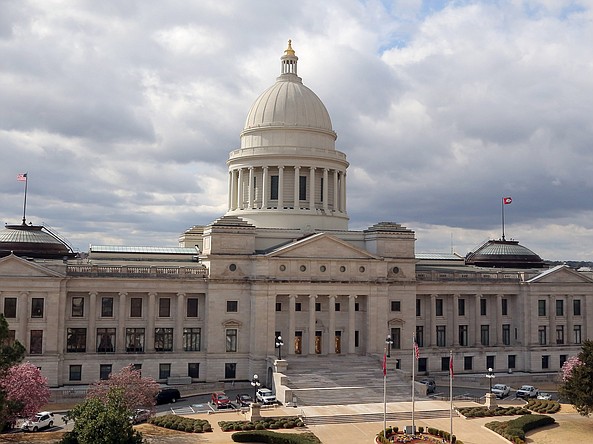
Arkansas State Capitol Front Door   Photograph by Kwadjo

Arkansas State Capitol Bronze Doors

QUESTION: I drive by the Capitol on my way home from work every day and I can’t help but admire its incredibly shiny front doors. What can you tell me about them? Thanks, Crosstown traffic

SCUTTLEBUTT: According to Richard Adcock, keeper of Arkansas’ State Capitol Doors, when President George W. Bush’s labor secretary Elaine Chao came to town she raved about them. She said that she wished our doors [U.S. Capitol] could look that shiny and good.

SKINNY: First let me say that Crosstown Traffic happens to be one of my favorite Jimi Hendrix tunes. I’d wager you like the song too.

According to the Secretary of State’s self guided tour,  the six east front entrance doors are made of bronze and are 10 feet tall, four inches thick and were purchased in 1910 from Tiffany’s in New York for $10,000.

Richard Adcock, Keeper of the Doors

Although I was unable to find detailed information about the purchase of the bronze doors I learned that Tiffany & Co. reached far beyond jewelry and glass. Charles Tiffany founded what would become one of the most prestigious companies of fine things in the world. But it was his son, Louis Comfort Tiffany that I believe would have had his hand in making the bronze doors that grace our Capitol today.

The Morse Museum in Winter Park, Florida houses one of the most comprehensive exhibits of Tiffany. In their leaflet Quest for Beauty, Louis Comfort Tiffany’s Life and Art they note that this Tiffany was a painter, decorator, architect, photographer, a designer of pottery, furniture, enamels and jewelry, in addition to glass lamps, windows, mosaics and vases. It was this Tiffany who opened the Tiffany Studios noted for among other things its bronze and metal work. He was commissioned by a number notables such as Mark Twain where he was asked to decorate his residence in Hartford, Connecticut, and President Chester A. Arthur to decorate the Blue Room, East Room, a corridor and the State Dining Room of The White House.

CHECK THIS OUT:

The Metropolitan Museum of Art

The Metropolitan Museum of Art in New York has a gallery in The American Wing devoted to the arts of Louis C. Tiffany. Find out more here.

CHECK THIS OUT:

Here is a tour of Arkansas’ State Capitol. Enjoy!

Capon Anyone?

January 30th, 2010
Cockerel by RobW

Cockerel, Photo by RobW

QUESTION: Hey Plainclothesman, I’ve been burning to ask you this….over the holidays…Thanksgiving to be exact, I waited til Thanksgiving morning to go shopping. The only fresh bird Kroger had left was a Capon, which I later learned was a neutered Rooster. Thank goodness I chose Salmon! Anyway, a friend of my Mom’s told me that  it actually tastes pretty good. Go figure. What can you tell me about Capon? Have you had it? Is it good?

Signed,

Capon For Thanksgiving 2010.

SCUTTLEBUTT: A well informed Arkansan who has lived in this state well over 50 years told Mrs. Plainclothesman that Governor Winthrop Rockefeller introduced Capon to Arkansas and had it imported here from New York.

Capon Photo by Sifu Renka

Capon, Photo by Sifu Renka

SKINNY: Well CFT 2010, I had not heard of Capon until your question but must say I can’t wait to experience it. As you’ve noted, CFT 2010 Capon is a neutered Rooster.

According to Harvey and Ellen Ussery of The Modern Homestead, “Caponizing has been practiced for thousands of years, by the Romans for example, as well as the ancient Chinese.” In their article, “Caponizing: Reviving a lost art,”  they state “as with castration of mammals, e.g., bull calves, the removal of testosterone-producing glands yields an animal that has better weight gain, is docile, and remains tender up to the day of slaughter.”

Our friends at Wikipedia tell us that “The Lex Faunia of 162 BCE forbade fattening hens as a way of conserving grain. In order to get around this the Romans castrated roosters, which resulted in a doubling of size.

Although I haven’t had Capon I believe your Mom’s friend is right…Capon appears to be a gourmand’s delight. Now as far as the scuttlebutt I could not find anything to connect Arkansas’ beloved Governor Rockefeller and Capon. However I did find this about Arkansas’ 27th governor, Thomas Jefferson Terral. Here’s an excerpt from a 1990 Arkansas Democrat Gazette article that shares Governor Terral’s interest and satisfaction with the tasty Capon.

“JOHN COOK OF North Little Rock joins those who are remembering incidents reported from the administration of Arkansas Gov. Tom Terrall. As somebody’s dinner guest, the governor was much taken with some fowl that was served. ” What is this?” he asked appreciatively. The host said, ” Governor, that’s capon.” Governor Terrall ate some more. ” Well, it’s delicious.” The chief executive was still remembering dinner when the evening ended and goodbyes were being said. “That meal was most enjoyable. If it’s possible, I would like very much to have a setting of those capon eggs.”

CHECK THIS OUT: How to castrate a rooster by a master at Sunshine Farms.

CHECK THIS OUT: Click here for Nasco’s Caponizing Kit.

CHECK THIS OUT: A beautiful Chinese caligraphy vignette of the cockerel

Be a history detective

November 20th, 2009
Photo by Melissa Tucker

Photo by Melissa Tucker

I asked Guy Lancaster, editor of the Encyclopedia of Arkansas History and Culture why he was so interested in Sundown towns.  Sundown towns started in the late 19th century and were places in Arkansas and our nation that blacks were not welcome after dark.  In fact the Encyclopedia of Arkansas History and Culture notes that sundown towns didn’t reach their peak until the 1970’s.

“Many people will tell you that the reason there were no blacks in various places throughout Arkansas was simply because blacks didn’t want to be there,” says Mr. Lancaster.  He believes that if we understand that we created sundown towns then we might be more mindful of the ways in which we develop our communities in the future.

Surely, making good use of our history has got to be one of the salient themes spackled in the walls of the new Arkansas Studies Institute in downtown Little Rock.  The institute along with other Arkansas historical troves, open to the public, like the Arkansas History Commission, The Mosaic Templars Cultural Center, and Philander Smith College Library to name a few are devoted to both recording and making Arkansas history accessible.  In fact the Encyclopedia of Arkansas History and Culture is available online.

I like to think of myself as a history detective and I love researching the proverbial who, what, where, when, why and how especially when the answers to those questions take me back a generation or more.  Recently, I was asked to find out what African-American life was like in 1904 Little Rock for an Emmy Award winning playwright based in Los Angeles.

I was charged with finding out what the social scene was like at the time.  What were the funeral traditions, foods, natural aesthetics like trees and vegetables that would be planted in a 1904 Little Rock backyard garden?  What were the names of interesting works of fiction and nonfiction from Arkansans writing at the time?

The greatest boon for me in working on this research project was discovering the very special places and people who document and freely share our collective history.  I learned that although 39 years had passed since the 13th amendment to the Constitution was enacted purportedly ending slavery, Little Rock and many other communities throughout the country were creating laws to segregate blacks from whites.  The lynching of African Americans was rampant and widespread and sundown towns were growing in number and becoming a fixed fact among us.

Nevertheless, the rhythmic quake of ragtime, ushered in by Arkansan, Scott Joplin was taking shape and making its way up north.  In 1904, Little Rock had three black colleges Shorter, Arkansas Baptist and Philander Smith.

Downtown’s West Ninth Street had African American businesses like The Children’s Drug Store, a pharmacy owned by African American Frank Barbour Coffin, who was also a published poet and The Mosaic Templars of America, an organization that provided financial, medical and social aid to African Americans in Arkansas and throughout the nation.  Known for its mutual aid, insurance and self help programs, The Mosaic Templars also established a nursing school.

Like Atlanta’s Auburn Avenue and Harlem’s 125th Street, African American beauty salons, pool halls, butchers and restaurants were all found downtown on Little Rock’s West Ninth Street.

A recent transplant to Little Rock from Atlanta, Georgia this research project availed me the opportunity to learn something of the rich and vibrant history of this great unassuming place called “The Natural State.”  But all you budding history detectives don’t need an out of state playwright to get you started…all you need is a question like why are there so many ranch styled houses in Little Rock? or who was Daisy Bates? or when and where was the first Christian Science church erected in Arkansas? or how did hot tamales become the Arkansan comfort food of choice, next to barbecue and where are they now?

———————————————————————————————

*This article first appeared in The Sync Weekly, April 1, 2009

Tamales, state food? Yes and No.

November 7th, 2009

Pot of Tamales photo by Snugg

Pot of Tamales photo by Snugg

QUESTION: I was at Whole Foods Market the other day looking for a tasty prepared hot treat for dinner. Don’t do this all the time, but I love Whole Foods and have just got to have it. My eyes fell on what the clerk told me were Tamales.  The clerk says Tamales is a state food of Arkansas. Is that true? Thanks, Whole Foods Always

SCUTTLEBUTT:  A delta man, maybe from Marianna or possibly Helena told the plainclothesman at the King Biscuit Blues Festival aka Arkansas Blues and Heritage Festival that Tamales is big business. He says you don’t see ‘em around as much as you used to back in the 50’s, 60’s, even 70’s. The delta man said someone in his family, an uncle he believes, had a knock out Tamales recipe. Everyone loved his uncle’s Tamales.  He loved making ‘em, but would share his recipe with no one. “You’d need a thousand dollars or so and just maybe you’d get that recipe from him,” says the delta man.

SKINNY:  Little Rock has an impressive organic-locally grown food movement. Whole Foods Market shares this cause and like you WFA, I enjoy their tasty prepared hot treats too. Check out Whole Foods Market Little Rock online for calendar of events, recipes, and so much more.

Now I don’t know if Arkansas actually has a state food. The Dutch Oven is the state’s cooking vessel and rice is the state grain.  As far as Tamales are concerned they are not recorded as a state food but have been a staple here for quite some time.  According to the folks who bring us the great Encyclopedia of Arkansas.net, “The St. Columbia family in Helena-West Helena (Phillips County) has been making and selling hot tamales since the late nineteenth century.” Today the family continues the tradition by selling Pasquale’s Hot Tamales online.  The St. Columbia family hail from Italy and have an interesting story.  Check out their website.

The folks at Encyclopedia of Arkansas.net tell us that most historians are convinced Tamales were brought to Arkansas, specifically the Delta by area Latino migrant laborers who worked in cotton fields up and down the Mississippi River in the 1920s and 1930s.

CHECK THIS OUT:

www.tamaletrail.com

www.tamaletrail.com

The Hot Tamale Trail is an oral history of folks from the Delta talking about this food.  The first entry, Ervin’s Hot Tamales, is notable (well they are all great) because the grandmother shares how her husband got the recipe from a guy in Arkansas for over $1000.

AND CHECK THIS OUT: To learn how to make Delta styled tamales click here!

CHECK THIS OUT TOO: On The Power of Tamale: Authentic Christmas Tamales – Food Network, a Mexican-American family shares their special tamale recipe. This clip is part of The Power of Food show on the Food Network.

Does Vimy Ridge have anything to do with the Civil War?

October 4th, 2009
Vimy Ridge Memorial by Jimmerman Fish

Vimy Ridge Memorial by Jimmerman Fish

QUESTION: I live on Vimy Ridge Road in Saline County, near Benton to be exact and am wondering if the name of the street has any Civil War significance. We’ve got a Civil War marker in the neighborhood and I was just wondering…?  Thanks, Mel.

SCUTTLEBUTT: None to speak of…..

SKINNY: “Settled by  a number of Germans who came to Saline County by way of Pennsylvania in the 1880’s, the community that is now known as Vimy Ridge was called Germania up until the first World war,” according to Michelle Wallace, contributing writer for the Arkansas Democrat-Gazette.

Vimy Ridge was a World War I battlefront. Our friends at Wikipedia informed the plainclothesman that “The Battle of Vimy Ridge was a military engagement which took place April 9-12, 1917. Historians attribute the success of the Canadian Corps in capturing the ridge to a mixture of technical and tactical innovation, meticulous planning, powerful artillery support, and extensive training, as well as the failure of the German Sixth Army to properly apply the German defensive doctrine.”

According to Wallace (Saline County’s Vimy Ridge residents rename town after World War I battle, Arkansas Democrat-Gazette, 2/5/06), “The battle of Vimy Ridge was deemed a success for the Allied Forces and the Germans in Otter Township, Saline County, saw fit to rename the Germania community in honor of the occasion.”

CHECK THIS OUT: As far as the Civil War goes Mel, here’s an interesting excerpt from “The History of Benton,” that I found at (http://www.benton.ar.gov/):

“In 1860, on the eve of the American Civil War the population of Arkansas had grown to 435,450 (including 111,115 slaves and 11,481 slave owners).  In 1860, Saline County’s population was 6,640 (including 749 slaves), and the population of Saline Township was 1,076 (not including slaves).  The relatively small number of slaves in the county was due in part to the poor soils that restrained the development of plantation agriculture.

The majority of Arkansas’ 1860 convention delegates represented areas where slave ownership was prevalent.  Hence, when President Lincoln called for 75,000 troops to put down the rebellion on May 6th, and Virginia along with Robert E. Lee joined the Confederacy, it is not surprising that Arkansas chose secession rather than fight against other slave states.  During the Civil War (1861-1865), Saline County provided several regiments (i.e., 15 full companies) of Confederate troops.  However, this did not prevent the fall of Little Rock to Union forces in 1863.  Subsequently, Benton was occupied by as many as 4 regiments of Union troops.  They were based at Fort Bussy, which was located near the current-day intersection of Carpenter and Military Roads, where Walgreen’s Drug Store now sits.  Built in the 1850s, the Shoppach House near Main Street and Military Road, is the oldest structure in Benton and was occupied by Union troops during the Civil War.  During 1863 and 1864, there were several skirmishes between Union and Confederate troops near Benton (e.g., Battle of Hurricane Creek on Old Military/Stagecoach Road).  Also in 1864, Union forces based in Little Rock and led by Major General Steele encountered mud and rain at Benton during a nearly disastrous military campaign to drive Confederate forces from southwest Arkansas.”

For the rest of this article and more on the history of Benton go to: www.benton.ar.gov/about/benton_history.doc

CHECK THIS OUT:The Arkansas Civil War Sesquicentennial Commission commemorates the 150th anniversary of the Civil War in Arkansas by sanctioning events, encouraging research and education programs related to Civil War Arkansas, and preserving the sites that witnessed the Civil War in Arkansas. The Civil War Sesquicentennial will be celebrated between 2011 and 2015.  Check out the website and take part in these upcoming events (you can even suggest an event of your own).

National Park Service

National Park Service

CHECK THIS OUT: The National Park Service has an awesome map marking the civil war battle sites in Arkansas.

Is HSV really that big?

September 11th, 2009

QUESTION: I do think Arkansas is the absolute best, the very, very, very best and I think everyone who lives here would agree with me. Recently, I had the opportunity to visit the amazing Hot Springs Village for the first time. It is truly an arresting place. I was struck by the land, there is so much of it and so much of it seemingly left untouched. My host, another native Arkansan told me that HSV is the largest gated community in the United States. It’s big, but is it really that big?

Thanks, Rockin’ Arky

SCUTTLEBUTT: None to speak of….

Hot Springs Village

Hot Springs Village

SKINNY: Rockin’ Arky, did you spend July 4th at Hot Springs Village? I did. It happened to be my first visit to HSV. It is big, really big, but wouldn’t you say that it is quite unassuming too.

Yes, there are lakes upon lakes and the golf course or golf courses go on for days it seems but then it’s got all those trees and places, idyllic natural places, spaces, undeveloped and left alone. I enjoyed that most of all.

According to privatecommunities.com, HSV is the largest private gated community in the United States of America. HSV is hailed as “a stunning 26,000 acre self-contained community featuring an award winning tennis center and nine amazing golf courses, including the four of the top ranked courses in Arkansas by Golf Digest magazine.”

HSV dedicates 25% of its land to green space. According to its website people are moving to the Village because of security. HSV has its own police and fire department, EMT emergency ambulance service, water, sewer and road maintenance departments. HSV is only accessible through five security gates. Homes are still being built and sold at HSV and they encourage folks to call toll free 800.483.7990 to make a reservation for a tour.

“At a press conference during a meeting of the Arkansas Industrial Development Commission on January 21, 1970, company president John A. Cooper, Jr. announced plans for the immediate development of Hot Springs Village.” According to History of Hot Springs Village: 1970-2000, “the project was up and running at an incredibly rapid pace.”

Check out History of Hot Springs Village to learn more of the Native Americans who lived in this part of Garland County and subsequent Spanish and French occupiers.

The Encyclopedia of Arkansas notes three different types of housing units other than individual private lots available at HSV. “Townhomes were constructed in the western end, neighborhoods are distributed throughout the village, and timeshares are located in one section of the village known as Los Lagos.” Furthermore, it states “Prices for houses and townhouses range from $40,000 to $510,000, with a median price of $145,000.

CHECK THIS OUT: HSV’s 40th Anniversary in 2010…be there!

Hot Springs Village 40th Anniversary

CHECK THIS OUT: Here’s a little ditty to make you grin. Enjoy!

Argenta, Liberia…really?

August 21st, 2009

QUESTION: Plainclothesman, is there such a thing as Argenta, Liberia? Thanks, Paolo.

Flag of Liberia

Flag of Liberia

SKINNY: Well Paolo, I don’t know if there is such a thing or place called Argenta, Liberia, but I thought you’d like to know that Victoria Tolbert, the wife of the former President of Liberia, President William Tolbert was from Argenta, Arkansas. According to Kenneth C. Barnes, author of Journey of Hope: The Back to Africa Movement in the 1880’s, “Mrs. Tolbert was the daughter of Isaac David who at the age of five emigrated with his family from Argenta (now North Little Rock, Arkansas)” to Liberia.

Barnes is the Chair of the History Department at the University of Central Arkansas in Conway. He chronicled the “Back to Africa Movement” for the Encyclopedia of Arkansas and says: “It was the most fascinating topic I’ve ever worked on and I was sad when it was over.”

The Tolberts were products of the Back to Africa Movement. Barnes notes for the Encyclopedia of Arkansas that: “The Back-to-Africa Movement mobilized thousands of African-American Arkansans who wished to leave the state for the Republic of Liberia in the late 1800s. Approximately 650 emigrants left from Arkansas, more than from any other American state, in the 1880s and 1890s, the last phase of organized group migration of black Americans to Liberia.” The Plainclothesman asked Barnes why he thought the largest number of emigrants from the United States to Liberia came from Arkansas.  Here’s what he shared:

  • The person who most served as a cheerleader for the Back to Africa Movement in the black community on a national level was Henry McNeal Turner, a bishop of the AME Church.  He lived in Atlanta, but his Episcopal district was Arkansas, Mississippi, and Indian Territory (today’s Oklahoma.)  As such, he came yearly to Arkansas to preside over annual church meetings at different locations, e.g. Little Rock, Batesville, Pine Bluff, Newport, Morrilton, and other towns, and always he preached enthusiastically about migration to Africa.  His presence in Arkansas was a factor.
  • A less obvious factor was how rapidly the pendulum swung in Arkansas from being a relatively good environment for people of color to a location of some of the worst oppression in the South.  In the 1870s and early to mid 1880s Arkansas’ black population grew more rapidly than any other southern state as land was cheaper, wages higher, and relatively more opportunities politically and economically for black people than areas of the deep South. A complicated set of circumstances in the 1880s made black voters holding the balance of power in elections and white Democrats responded with a harsh clampdown that took away voting rights and ushered in Jim Crow discrimination in the harshest of forms between 1888 and 1892.  So very quickly Arkansas went from a desirable place for black people to a mirror image of Mississippi and South Carolina style oppression.  Many of these black newcomers who had come to Arkansas with high hopes gave up on the South and in fact America and determined to leave for Africa.
  • A third factor is the organic, somewhat epidemic nature of the Back to Africa Movement. I often call it Liberia fever, for you could see it spreading from community to community almost like a virus.  It was an emotional even somewhat of a religious movement that fed off of its own momentum.

This is just a summary of Barnes’ arguments, for more detail check out the entry “Back to Africa Movement” in the Encyclopedia of Arkansas and buy Journey of Hope: The Back to Africa Movement in the 1880s.

CHECK THIS OUT: “Learning to Love Africa” – Monique Maddy speaks at Google. Upon graduating from Harvard Business School, Maddy, born in Liberia and educated in Britain and the U.S., relocates to Tanzania to execute a start-up business providing telephone service. With the excitement attendant to starting a new company and the soul-searching of a young woman on a mission, Maddy brings personal experience and a different perspective on the troubled history of conquest and colonization of Africa, including the resettlement of American slaves in Liberia. Having worked for the UN, Maddy also brings a perspective on capitalism versus the benevolent efforts of world organizations. She contrasts their ineffectiveness with the entrepreneurial heritage of the Mandigo….